
 Call Us Now: 888.945.2611

Call Us Now: 888.945.2611
We Offer Comprehensive Recycling Services for Your
Used Electronics
and Other Electrical Equipment.

Feb 01, 2026

In healthcare, a data breach is not just a financial event. It is a patient trust event. In early 2025, a Canadian healthcare organization discovered that unauthorized access to its systems had been underway for weeks before detection, ultimately exposing records of approximately 1.9 million patients. What that incident underscored is a risk many Canadian healthcare organizations have not fully addressed: data exposure does not only occur through network intrusions. It occurs through improperly retired IT equipment.
Every server, workstation, tablet, imaging machine, and network device that leaves a healthcare facility without certified data destruction and a documented chain of custody is a potential breach event. This guide covers the compliance framework, the full scope of devices that require secure retirement, and the documentation standards that protect your organization under PHIPA, PIPEDA, and Quebec Law 25. For a broader foundation on ITAD, see the eCycle Solutions guide to IT Asset Disposition in Canada.
| Regulation / Fact | What It Means for Healthcare IT Disposal |
|---|---|
| PHIPA (Ontario) | Health information custodians must protect PHI through certified destruction; AMPs up to CAD 500,000 per organization effective January 2024. |
| PIPEDA (Federal) | Requires secure destruction of personal data when no longer needed; breach notification to OPC when there is a real risk of significant harm. |
| Quebec Law 25 (2025) | Penalties up to CAD 25M or 4% of global turnover; 72-hour breach notification window; applies to any organization with Quebec data flows. |
| Average healthcare breach cost | USD 7.42 million globally — approximately 40% above the cross-industry average. |
| Documentation retention | Chain of custody and destruction certificates should be retained for a minimum of 24 months per PIPEDA breach record-keeping requirements. |
| Absent documentation = absent action | Regulators treat the inability to produce destruction records the same as never having performed destruction. |
Healthcare organizations in Canada operate within a more demanding privacy compliance environment than virtually any other sector. The obligation does not end at the moment a device is powered off. It ends only when certified destruction has been performed, documented, and confirmed.
PHIPA requires hospitals, clinics, long-term care facilities, pharmacies, and diagnostic laboratories to take reasonable steps to ensure personal health information is protected against theft, loss, and unauthorized use or disclosure. This obligation extends directly to the moment a device leaves the facility. As of January 1, 2024, the Information and Privacy Commissioner of Ontario has the authority to issue administrative monetary penalties of up to CAD 50,000 for individuals and CAD 500,000 for organizations.
Fully in force as of 2025, Quebec Law 25 applies to any organization that collects, uses, or communicates personal information in Quebec. For healthcare organizations with cross-provincial operations or data flows, Law 25 is the most demanding applicable framework, with penalties mirroring the GDPR and a 72-hour breach notification requirement when there is a risk of serious injury.
|
Common oversight: Many healthcare organizations focus only on conventional IT equipment and miss significant exposure.
Any device that has ever stored personal health information requires certified data destruction — not just laptops and desktops.
|
The universe of devices requiring certified data destruction in a clinical environment is substantially broader than most organizations plan for:
The eCycle Solutions data destruction service is built to address this full equipment spectrum, not just conventional desktop hardware.
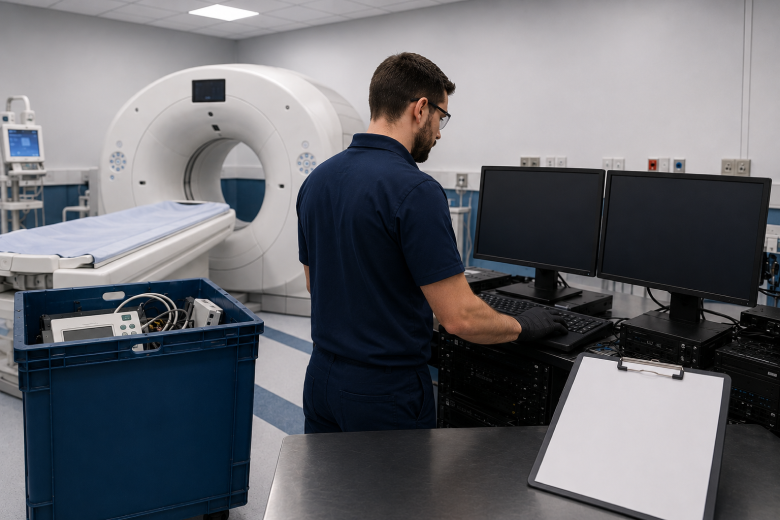
Chain of custody documentation is not an administrative nicety in healthcare ITAD. It is the evidentiary record that demonstrates your organization met its legal obligations from the moment a device was decommissioned through its final disposition. In a regulatory investigation, an audit, or a breach allegation, chain of custody records are the foundation of your defence.
A compliant chain of custody includes:
Healthcare organizations that cannot produce these records for every retired device are, from a regulatory standpoint, in the same position as organizations that never performed the destruction at all. The absence of documentation is treated as the absence of action.
The data destruction method applied to a healthcare device is both a compliance decision and a financial one. Certified data wiping, performed to recognized standards and documented with a per-device certificate, allows a device in good physical condition to be refurbished and resold — generating value recovery while meeting legal requirements under PIPEDA and PHIPA.
Physical destruction — including hard drive shredding, degaussing, or pulverization — is the appropriate method for devices that have stored particularly sensitive data categories, for devices whose storage media cannot be reliably wiped due to hardware failure, or for organizations operating under contractual or regulatory requirements specifying physical destruction. eCycle Solutions’ resale services and certified destruction services are both built for the healthcare context, with the documentation required by PHIPA and Law 25.
Which Canadian privacy laws apply to retired healthcare IT equipment?
In Ontario, PHIPA applies to health information custodians and requires certified destruction when personal health information is no longer needed, with AMPs up to CAD 500,000 per organization. PIPEDA applies at the federal level and governs cross-border data transfers and federally regulated entities. Quebec’s Law 25, fully in force as of 2025, carries penalties up to CAD 25 million or 4 percent of global turnover and requires breach notification within 72 hours. All three frameworks treat the improper disposal of IT equipment containing personal information as a reportable privacy event.
What devices in a healthcare organization require certified data destruction?
Any device that has ever stored personal health information requires certified data destruction. This includes conventional IT equipment such as laptops, desktops, and servers, as well as clinical equipment including imaging machines, diagnostic devices, patient monitoring systems, networked workstations, and network infrastructure components such as routers, switches, and firewall appliances that may store access logs or cached credentials.
What documentation does a healthcare organization need to satisfy PHIPA requirements after IT equipment is disposed of?
A compliant PHIPA documentation package includes a Certificate of Destruction issued per device, a chain of custody record covering every stage from pickup through final disposition, the data destruction method applied and the standard it meets, and where applicable, recycling or resale attestation confirming the device’s downstream path. These records should be retained for a minimum of 24 months in alignment with federal breach record-keeping requirements under PIPEDA.
Why is chain of custody documentation specifically important in healthcare ITAD?
Chain of custody documentation is the evidentiary record that demonstrates your organization fulfilled its legal obligations from decommission through final disposition. In a PHIPA investigation, an audit, or a class action proceeding, the absence of chain of custody records is treated the same as the absence of any protective action. Organizations that cannot demonstrate documented custody of every retired device are carrying an unquantified legal exposure that proper ITAD documentation eliminates.
eCycle Solutions serves healthcare organizations across Canada with compliance-forward
ITAD, certified data destruction, and chain of custody documentation built for
PHIPA, PIPEDA, and Quebec Law 25.

eCycle Solutions is my most recommended and is a highly reputed electronics solutions company. Their team is highly efficient and supportive! My experience with them was so great that I will consider them in the future for sure! Highly recommended!

It is so important to properly recycle your electronics and ensure they do not end up in a landfill. eCycle Solutions is my number one choice! They ensure your electronics are recycled properly. Highly recommended!
eCycle Solutions is Canada’s best electronic recycler. Great team, polite and friendly customer service. Thank you eCycle Solutions for doing a wonderful job. Highly recommended!
