
 Call Us Now: 888.945.2611

Call Us Now: 888.945.2611
We Offer Comprehensive Recycling Services for Your
Used Electronics
and Other Electrical Equipment.

Sep 05, 2026
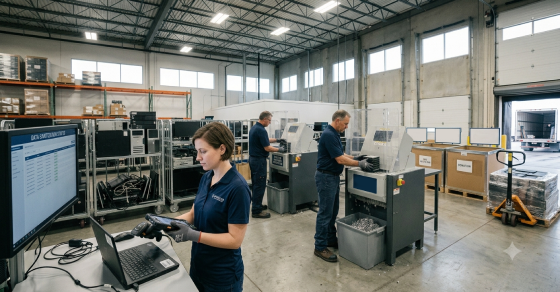
For procurement and IT teams, understanding the ITAD process means knowing what happens to your assets at each stage: when they’re logged, how they’re tracked, when data is destroyed, how equipment is evaluated for resale or recycling, and what documentation you receive when the process is complete.
This guide breaks the ITAD process into seven practical stages, from defining the initial inventory and arranging pickup through data destruction, value recovery and final reporting. At each stage, we’ll explain what happens, what records or documentation you should expect, and where problems or delays are most likely to occur.
Everything that follows depends on having an accurate starting inventory. Before any equipment moves, you and the ITAD provider should agree on what is being collected, including asset types, estimated quantities, locations and which devices contain data-bearing media.
Your asset register provides the baseline for reconciling the final report. If it is incomplete or out of date, discrepancies can be much harder to investigate once the equipment has left your site. Reviewing and updating the register before pickup can prevent avoidable reconciliation issues later.
Output: A scope of work and quote, including any applicable resale revenue share. Our ITAD service explains how the broader process and commercial structure work.
Once the scope is confirmed, pickup is scheduled and the documented chain of custody begins. Assets are collected according to the agreed inventory and transported under controlled procedures so they can be tracked from your site through processing and final disposition.
For organizations with multiple locations, national coverage can simplify the process considerably. eCycle Solutions provides pickup services across Canada, allowing multi-site projects to be managed through one ITAD program rather than coordinating separate providers and reporting processes in each region.
Output: Pickup and chain-of-custody documentation for the assets collected.
At the processing facility, assets are checked against the pickup records and reconciled with the expected inventory. Any discrepancies or exceptions are flagged, and each device is directed to the appropriate next step based on its condition, data requirements and potential for reuse.
This is also the point where missing assets should be investigated. If a device appears on your register but was never received, it may represent a security or inventory issue that is easier to resolve while the chain of custody is still fresh.
Data-bearing media is sanitized using a method appropriate to the device, the sensitivity of the information and the required level of assurance. NIST Special Publication 800-88 is a widely used reference for media sanitization and defines three methods: Clear, Purge and Destroy.
NIST published Revision 2 of SP 800-88 in September 2025, replacing Revision 1. The updated guidance places more emphasis on managing sanitization as a documented enterprise program and validating that the chosen method was effective. It also distinguishes between logical and physical sanitization techniques and expands the guidance to account for newer forms of information storage. If your internal policy still cites Revision 1, it is worth reviewing against the current standard.
In practice, reusable media may be securely erased using an appropriate logical sanitization method, while failed or unreadable drives may need to be physically destroyed because they can’t be reliably overwritten. Our ITAD data destruction guide explains NIST 800-88 methods, verification and media-specific considerations in more detail.
The sanitization method and outcome should be recorded against the asset or media serial number.
Output: Per-asset sanitization records that support the Certificate of Destruction and final reporting provided at Stage 7.
Once data has been securely removed, assets that may still have value are tested and graded. Technicians assess functionality, cosmetic condition and market value to determine whether each device is suitable for resale, repair, refurbishment or material recovery.
Equipment with resale potential may be repaired or refurbished to improve its condition and market value before remarketing. The decision depends on factors such as age, condition, demand and the cost of any required work.
This stage determines how much value can be recovered from retired equipment. For suitable assets, resale proceeds can help offset the cost of the ITAD program. Our resale and refurbishment service covers testing, repair, refurbishment and remarketing, with the option to direct resale proceeds to a charity of the client’s choice.
Assets approved for resale are remarketed, while equipment that has reached the end of its useful life is processed for material recovery. Devices are dismantled and separated into commodity streams such as metals, plastics and circuit boards, which are then sent to qualified downstream processors.
eCycle Solutions operates with a goal of 100% landfill diversion, keeping recoverable materials out of landfill and returning them to manufacturing supply chains wherever possible.
Independent certifications help provide oversight of this downstream process. R2v3 includes requirements for qualifying and managing downstream vendors, while standards such as ISO 9001, ISO 14001 and ISO 45001 cover quality, environmental and occupational health and safety management systems. Our certifications page lists eCycle Solutions’ current certifications and the facilities to which they apply.
The final reporting package provides the documentation needed to close out the project and support internal compliance or audit requirements. Depending on the scope of the engagement, it may include:
Together, these records give your organization a documented account of what happened to each asset from collection through final disposition.
For a closer look at what happens to the equipment itself after secure processing, our companion guide to what happens to your IT assets after secure disposition follows the assets through reuse, resale and recycling.
ITAD timelines vary by asset volume, location, data destruction requirements and any discrepancies found during reconciliation. For a standard engagement, however, the first 30 days may follow a sequence like this:
| When | What is happening | What you may receive |
|---|---|---|
| Day 0 | Pickup and chain-of-custody documentation | Pickup and chain-of-custody records |
| Days 1 to 5 | Transport, facility intake and reconciliation against the expected inventory | Exception notice if discrepancies are identified |
| Days 5 to 15 | Data sanitization and verification, with physical destruction where required | Processing records are being compiled |
| Days 15 to 25 | Testing, grading and refurbishment; non-resale assets move to material recovery | Resale valuation or related updates where applicable |
| Days 25 to 30 | Final records are reconciled and reporting is prepared | Certificate of Destruction and final asset reporting |
| After Day 30 | Remarketing continues for assets approved for resale | Settlement reporting where resale proceeds apply |
Two factors can extend that timeline. The first is volume: a large multi-site decommission naturally takes longer to process than a few hundred laptops. The second is reconciliation. If an asset appears on your register but can’t be matched to the equipment received, that exception may need to be resolved before the final reporting package can be completed. That’s another reason to start with an accurate asset register in Stage 1.
If certain storage media requires destruction on a much shorter timeline, ask whether on-site or witnessed destruction is appropriate for those assets. eCycle Solutions offers both on-site and off-site data destruction, allowing higher-risk media to be handled separately from the standard ITAD workflow when required.
IT Asset Disposition (ITAD) is the controlled retirement of IT equipment that is no longer needed. The process typically includes secure collection and tracking, data sanitization or destruction, testing and refurbishment of reusable assets, resale where appropriate, responsible recycling of remaining equipment, and final reporting that documents what happened to each asset.
The ITAD process is broken into seven stages: scope and inventory planning, scheduled pickup and chain of custody, facility intake and reconciliation, certified data destruction, testing and grading, resale or material recovery, and final reporting. After data has been securely removed, reusable equipment may be tested, refurbished and remarketed, with resale proceeds returned to the client or directed to a charity where applicable. Equipment that can’t be reused is processed for material recovery, with components and commodities separated for responsible downstream recycling.
ITAD timelines depend on the number and type of assets, locations involved, data destruction requirements and any inventory discrepancies that need to be resolved. A standard engagement may move through processing and final reporting within roughly 30 days, while larger or more complex projects can take longer. Resale and settlement may continue after the main processing and reporting stages are complete.
ITAD documentation may include a Certificate of Destruction, a reconciled asset report, chain-of-custody records and final disposition details showing how assets were processed. Where resale proceeds apply, the final package may also include settlement reporting. The level of asset detail required will depend on your organization’s security, compliance and audit requirements.
Yes. eCycle Solutions provides ITAD services nationwide, allowing organizations with locations in multiple provinces to coordinate asset disposition through a single provider.
Before scheduling your next ITAD project:
Planning an IT asset decommission? Request a quote or call 888.945.2611 to discuss your scope, locations and reporting requirements.
Tricia Oldfield is VP Sales & Marketing at eCycle Solutions, Canada’s certified e-waste recycler and ITAD provider. R2v3 certified.

eCycle Solutions is my most recommended and is a highly reputed electronics solutions company. Their team is highly efficient and supportive! My experience with them was so great that I will consider them in the future for sure! Highly recommended!

It is so important to properly recycle your electronics and ensure they do not end up in a landfill. eCycle Solutions is my number one choice! They ensure your electronics are recycled properly. Highly recommended!
eCycle Solutions is Canada’s best electronic recycler. Great team, polite and friendly customer service. Thank you eCycle Solutions for doing a wonderful job. Highly recommended!
