
 Call Us Now: 888.945.2611

Call Us Now: 888.945.2611
We Offer Comprehensive Recycling Services for Your
Used Electronics
and Other Electrical Equipment.

Feb 15, 2026

Every year, Canadian organizations retire thousands of laptops, servers, workstations, and mobile devices. Most treat this moment as a cost to absorb rather than a financial opportunity to capture. That assumption is expensive.
The global enterprise IT asset disposition market was valued at USD 7.74 billion in 2025 and is projected to reach USD 21.51 billion by 2034. Research consistently shows that organizations executing ITAD correctly recover 10 to 30 percent of an asset’s original lifecycle value — while eliminating exposure to data breach liability that can run into millions of dollars per incident. For a complete overview of what responsible asset retirement looks like, visit the eCycle Solutions ITAD services page.
This guide shows IT directors, CFOs, and procurement leaders how to transform retired hardware from a sunk cost into a strategic asset — covering the financial mechanics, the Canadian compliance context, and the four levers that determine what you actually recover.
| Metric | What It Means for Your Program |
|---|---|
| 10–30% value recovery | Typical resale return on original purchase price when devices are retired at the right time with a certified provider. |
| 40–60% value loss | Potential recovery lost by delaying decommissioning past the 3–4 year window. |
| USD 7.42M | Average cost of a healthcare data breach globally — ~40% above the cross-industry average. |
| CAD 500,000 | Max PHIPA administrative penalty per organization (Ontario, effective January 2024). |
| CAD 25M or 4% of turnover | Max penalty under Quebec Law 25 (fully in force 2025) — the strictest privacy regime in Canada. |
| ~85% | Industry average inventory accuracy — meaning ~15% of devices are mis-catalogued and routed to lower-value channels by default. |
Canadian organizations must navigate a layered privacy framework that creates direct financial exposure at the point of hardware retirement. PIPEDA governs private-sector data handling at the federal level. Ontario’s PHIPA applies to health information custodians, with administrative monetary penalties of up to CAD 500,000 per organization now in effect. Quebec’s Law 25, fully enforced in 2025, carries penalties reaching 4 percent of global turnover or CAD 25 million — whichever is higher.
A single retired device that leaves your facility without certified data destruction is a compliance exposure under any of these frameworks. The LifeLabs breach in Canada, which compromised records for approximately 15 million patients, resulted in class action settlements approaching CAD 10 million. The financial calculation for Canadian enterprises therefore starts with risk avoidance before it reaches revenue recovery. Learn more about eCycle Solutions’ certified data destruction services.
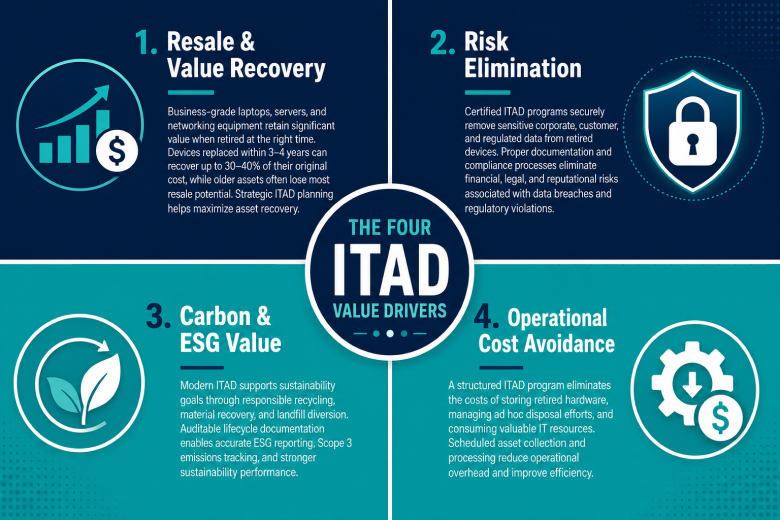
Business-grade laptops, workstations, servers, and networking gear retain meaningful market value when retired at the right time and processed accurately. The critical variable is timing: a three-to-four-year-old business laptop may recover 30 to 40 percent of its original purchase price. The same device at five to six years old may recover 10 percent or less, and refurbishment costs may exceed its market value entirely. IT directors should involve their ITAD partner at the point of procurement planning, not the point of device retirement.
This is the financial line most CFOs undervalue because it represents a cost that never appears on the income statement — until it does. Certified, documented ITAD removes the balance sheet exposure created by unprocessed devices carrying sensitive corporate, customer, and regulated personal data. For publicly traded organizations and those operating under PHIPA or Law 25, this is a quantifiable liability that a properly structured program eliminates entirely.
Mandatory Scope 3 carbon accounting disclosures require enterprises to account for downstream hardware retirement in sustainability reporting. ITAD providers issuing auditable lifecycle documentation allow finance teams to accurately report avoided emissions, landfill diversion volumes, and material recovery metrics — supporting corporate sustainability disclosures and in some cases qualifying organizations for sustainability-linked financing terms. eCycle Solutions’ electronics recycling services are built to generate this documentation on every engagement.
Organizations without a structured ITAD program routinely store retired hardware in server rooms, IT closets, and warehouse space for months or years. The carrying cost of that storage, combined with the labour required for ad hoc disposal coordination, represents a real and recurring expense that a managed pickup and processing service eliminates on a predictable schedule.

What is ITAD ROI and how do enterprises calculate it?
ITAD ROI is the measurable net financial return generated by a structured IT Asset Disposition program. It combines direct revenue from device resale and material recovery, avoided costs from data breach liability, regulatory compliance savings, and operational savings from eliminating ad hoc storage and disposal. Enterprises executing ITAD correctly typically recover 10 to 30 percent of an asset’s original lifecycle value before factoring in breach risk elimination.
How much can a Canadian enterprise realistically recover from retired hardware?
Recovery rates depend on device type, age, condition, and processing speed. Business-grade laptops retired at three to four years consistently deliver the strongest recovery. Organizations lose 40 to 60 percent of potential value by delaying decommissioning past the optimal window — making timing a critical financial variable rather than a scheduling convenience.
Why does certified data destruction affect resale value?
Certified data wiping, documented through chain of custody records and formal destruction certificates, allows a device to be sold into verified resale channels where buyers pay premium prices for provenance-backed equipment. Devices processed without certified destruction documentation are routed to lower-value outlets or material recycling, dramatically reducing per-device recovery. The certificate also provides compliance documentation required under PIPEDA, Ontario PHIPA, and Quebec Law 25. Learn more about eCycle Solutions’ certified data destruction services.
How does a well-run ITAD program support ESG and sustainability reporting?
A certified ITAD program generates auditable documentation covering material diversion from landfill, recycled material volumes, avoided carbon emissions, and per-device chain of custody records. This satisfies Scope 3 downstream emissions reporting, supports corporate sustainability disclosures, and in some cases qualifies organizations for sustainability-linked financing. eCycle Solutions’ electronics recycling services are built to generate this level of documentation on every engagement.
eCycle Solutions helps Canadian enterprises recover maximum value from retired hardware —
with certified data destruction and full compliance documentation on every project.

eCycle Solutions is my most recommended and is a highly reputed electronics solutions company. Their team is highly efficient and supportive! My experience with them was so great that I will consider them in the future for sure! Highly recommended!

It is so important to properly recycle your electronics and ensure they do not end up in a landfill. eCycle Solutions is my number one choice! They ensure your electronics are recycled properly. Highly recommended!
eCycle Solutions is Canada’s best electronic recycler. Great team, polite and friendly customer service. Thank you eCycle Solutions for doing a wonderful job. Highly recommended!
